
THine Value Camera Kits Developed in Collaboration with APPRO.PHO, Delivering High Image Quality and Long Transmission Distances
2024.06.27
- Article
- Use Case
Based in New Taipei City, Taiwan, Appro Photoelectronics (APPRO.PHO) is a design house with proprietary expertise in image quality tuning for camera-related systems. THine Electronics currently supplies APPRO.PHO with a range of transmitter and receiver ICs incorporating its high-speed serial interface technology, V-by-One HS. APPRO.PHO has been developing camera kits based on these ICs and has already begun commercializing several models.
All of these camera kits are designed for use with NVIDIA single-board computers, including the Jetson AGX Orin, Jetson Orin NX / Orin Nano, Jetson AGX Xavier, Jetson Xavier NX, Jetson Xavier TX2 NX, and Jetson Nano. These single-board computers are known for their powerful computing and AI inference capabilities. As a result, APPRO.PHO is targeting mid-range to high-end applications. Specific applications include automotive equipment, industrial systems, medical endoscopes, and surveillance cameras. “The primary users of APPRO.PHO’s camera kits are electronics manufacturers in Taiwan, Europe, and the United States,” said a member of THine’s Taiwan sales team.
All of these camera kits are designed for use with NVIDIA single-board computers, including the Jetson AGX Orin, Jetson Orin NX / Orin Nano, Jetson AGX Xavier, Jetson Xavier NX, Jetson Xavier TX2 NX, and Jetson Nano. These single-board computers are known for their powerful computing and AI inference capabilities. As a result, APPRO.PHO is targeting mid-range to high-end applications. Specific applications include automotive equipment, industrial systems, medical endoscopes, and surveillance cameras. “The primary users of APPRO.PHO’s camera kits are electronics manufacturers in Taiwan, Europe, and the United States,” said a member of THine’s Taiwan sales team.
Confidence in Image Quality Tuning Technology
In general, integrating camera functionality into electronic equipment is a highly challenging design task. Camera kits significantly reduce this complexity, making it much easier to incorporate camera functions into electronic products (Fig. 1).

When integrating camera functionality into an electronic device, the first step is to assemble the necessary hardware for video transmission. In addition to a camera module equipped with a CMOS image sensor and an image signal processor (ISP) for capturing and processing video signals, designers must also select high-speed serial transmission transmitter and receiver ICs for long-distance video transmission. This is because the commonly used MIPI-CSI2 camera interface can only transmit signals over distances of approximately 30 cm.
Software configuration and development are also essential. For example, parameters such as autofocus, exposure, white balance, and noise reduction must be configured within the ISP, while register settings must also be programmed for the high-speed serial transmission transmitter and receiver ICs.
However, the work does not end there. Even after connecting the hardware and properly configuring the software, the resulting image may not match expectations. In some cases, the desired image quality cannot be achieved. When that happens, troubleshooting becomes necessary. Troubleshooting typically requires considerable time.
“APPRO.PHO has advanced image quality tuning technology and is highly confident in the image quality delivered by its camera kits” (Fig. 2). This confidence stems from the use of an external image signal processor. Because NVIDIA does not disclose the source code for its image quality tuning functions, relying solely on its single-board computers yields only basic image quality. To overcome this limitation, APPRO.PHO has implemented its proprietary image quality tuning algorithms on an external ISP, resulting in superior image quality.
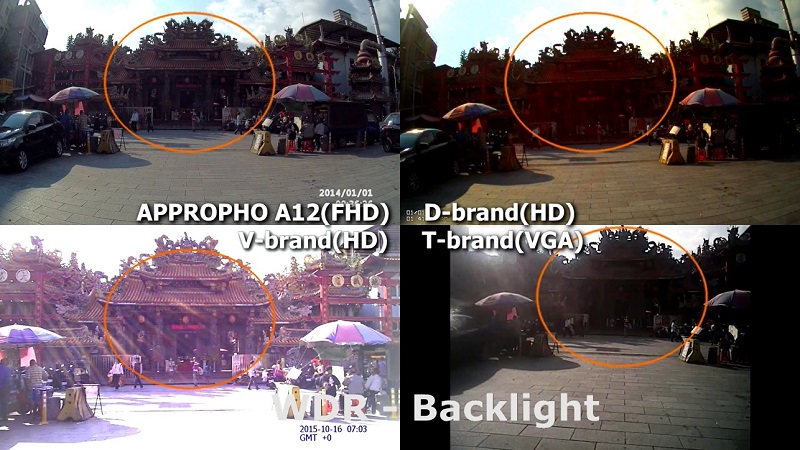
Fig. 1 Camera Kit Configuration
When integrating camera functionality into an electronic device, the first step is to assemble the necessary hardware for video transmission. In addition to a camera module equipped with a CMOS image sensor and an image signal processor (ISP) for capturing and processing video signals, designers must also select high-speed serial transmission transmitter and receiver ICs for long-distance video transmission. This is because the commonly used MIPI-CSI2 camera interface can only transmit signals over distances of approximately 30 cm.
Software configuration and development are also essential. For example, parameters such as autofocus, exposure, white balance, and noise reduction must be configured within the ISP, while register settings must also be programmed for the high-speed serial transmission transmitter and receiver ICs.
However, the work does not end there. Even after connecting the hardware and properly configuring the software, the resulting image may not match expectations. In some cases, the desired image quality cannot be achieved. When that happens, troubleshooting becomes necessary. Troubleshooting typically requires considerable time.
“APPRO.PHO has advanced image quality tuning technology and is highly confident in the image quality delivered by its camera kits” (Fig. 2). This confidence stems from the use of an external image signal processor. Because NVIDIA does not disclose the source code for its image quality tuning functions, relying solely on its single-board computers yields only basic image quality. To overcome this limitation, APPRO.PHO has implemented its proprietary image quality tuning algorithms on an external ISP, resulting in superior image quality.
Fig. 2 APPRO.PHO's Image Quality Tuning Technology
Chosen for Superior Transmission Performance
For camera kits requiring long-distance video transmission, APPRO.PHO selected THine’s V-by-One HS-compatible high-speed serial transmission transmitter and receiver ICs. However, similar transmitter and receiver ICs are also available from analog semiconductor manufacturers that compete with THine. There are several options on the market. Why, then, was V-by-One HS selected? There are two primary reasons.
The first is its superior transmission performance. V-by-One HS supports transmission speeds of up to 4 Gbps per lane. Competing products may also support 4 Gbps transmission, but their speeds are fixed at 4 Gbps, meaning that even an 800 Mbps video signal must be transmitted at 4 Gbps. In other words, an 800 Mbps signal still requires a cable capable of supporting 4 Gbps. V-by-One HS, by contrast, offers flexible transmission speeds. For example, when the input signal is 800 Mbps, 8B10B encoding increases the transmission rate to 1 Gbps, which can then be transmitted directly (Note 1). There is no need to increase the speed to 4 Gbps. As a result, lower-cost cables rated for 1 Gbps can be used.
The second reason is the availability of detailed technical support. As mentioned earlier, THine maintains a sales office in Taiwan and has dedicated support personnel based there. If a technical issue arises, support staff can respond immediately and work closely with engineers in Japan to provide a solution quickly. By contrast, competing suppliers often struggle to provide the same level of support to camera kit developers with relatively low production volumes.
(Note 1) Current V-by-One HS products support flexible transmission speeds, although fixed-speed products may be introduced in the future.
The first is its superior transmission performance. V-by-One HS supports transmission speeds of up to 4 Gbps per lane. Competing products may also support 4 Gbps transmission, but their speeds are fixed at 4 Gbps, meaning that even an 800 Mbps video signal must be transmitted at 4 Gbps. In other words, an 800 Mbps signal still requires a cable capable of supporting 4 Gbps. V-by-One HS, by contrast, offers flexible transmission speeds. For example, when the input signal is 800 Mbps, 8B10B encoding increases the transmission rate to 1 Gbps, which can then be transmitted directly (Note 1). There is no need to increase the speed to 4 Gbps. As a result, lower-cost cables rated for 1 Gbps can be used.
The second reason is the availability of detailed technical support. As mentioned earlier, THine maintains a sales office in Taiwan and has dedicated support personnel based there. If a technical issue arises, support staff can respond immediately and work closely with engineers in Japan to provide a solution quickly. By contrast, competing suppliers often struggle to provide the same level of support to camera kit developers with relatively low production volumes.
(Note 1) Current V-by-One HS products support flexible transmission speeds, although fixed-speed products may be introduced in the future.
Transmitting 4K60fps Signals Over 7 Meters
APPRO.PHO currently offers five camera kits compatible with V-by-One HS. Two of those products are introduced below.
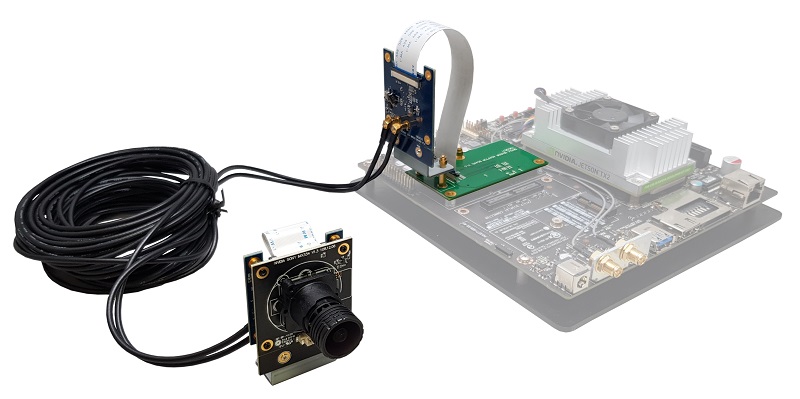
The first is the A-10 camera kit (Fig. 3). Its key feature is the ability to transmit 4K (3820 × 2160) video at 60 fps over long distances. “In practice, it can transmit video over distances of up to 7 meters. In terms of transmission range, it is a leading solution in the industry.” The CMOS image sensor used is Sony’s IMX334. The system uses the THCV241A-P as the V-by-One HS transmitter IC and the THCV242A-P as the receiver IC for long-distance transmission. The camera module and receiver board are connected using two coaxial cables.
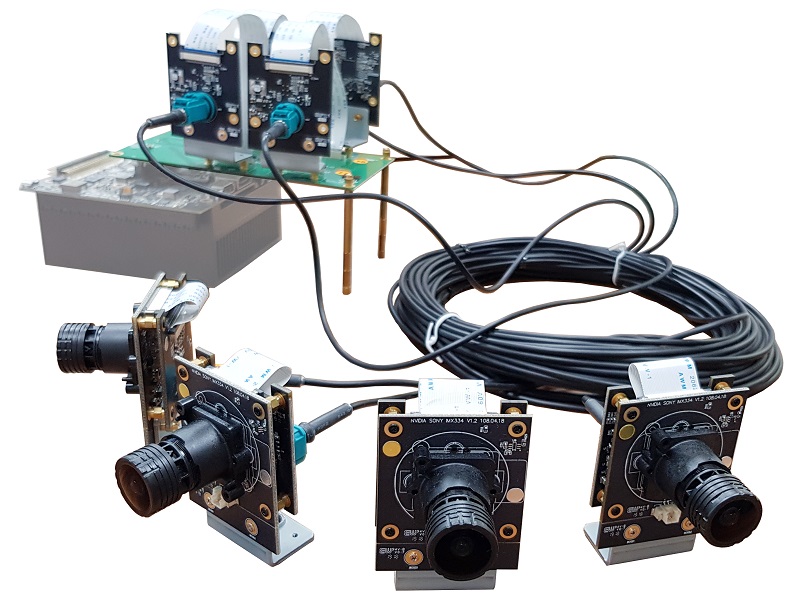
The second product is the A-07 camera kit (Fig. 4). Its defining feature is support for up to four camera modules. It also includes four receiver boards, connected via four coaxial cables. Each camera can transmit 4K (3820 × 2160) video at 30 fps. All four cameras use Sony’s IMX334 CMOS image sensor. Four THCV241A-P transmitter ICs and four THCV242A-P receiver ICs are used. The kit is intended for applications such as surveillance, security, and automotive cameras.
THine has already commercialized the THCV244A-QP, a receiver IC that integrates four V-by-One HS-compatible receiver circuits into a single chip. By using this IC, the receiver circuitry can be consolidated into a single chip.
Going forward, THine and APPRO.PHO plan to strengthen their collaboration further and bring camera kits tailored to a wide range of market needs to customers.
End
The first is the A-10 camera kit (Fig. 3). Its key feature is the ability to transmit 4K (3820 × 2160) video at 60 fps over long distances. “In practice, it can transmit video over distances of up to 7 meters. In terms of transmission range, it is a leading solution in the industry.” The CMOS image sensor used is Sony’s IMX334. The system uses the THCV241A-P as the V-by-One HS transmitter IC and the THCV242A-P as the receiver IC for long-distance transmission. The camera module and receiver board are connected using two coaxial cables.
Fig. 3 Camera Kit Supporting 4K60fps
The second product is the A-07 camera kit (Fig. 4). Its defining feature is support for up to four camera modules. It also includes four receiver boards, connected via four coaxial cables. Each camera can transmit 4K (3820 × 2160) video at 30 fps. All four cameras use Sony’s IMX334 CMOS image sensor. Four THCV241A-P transmitter ICs and four THCV242A-P receiver ICs are used. The kit is intended for applications such as surveillance, security, and automotive cameras.
Fig. 4 Camera Kit Supporting Four Camera Connections
THine has already commercialized the THCV244A-QP, a receiver IC that integrates four V-by-One HS-compatible receiver circuits into a single chip. By using this IC, the receiver circuitry can be consolidated into a single chip.
Going forward, THine and APPRO.PHO plan to strengthen their collaboration further and bring camera kits tailored to a wide range of market needs to customers.
End