
THine Value From Metal to Optical, and Then to Free Space: Expanding Connection Methods for IOHA:B
2026.04.21
- NEW
- Article
- Solution
Even semiconductor devices developed for a specific purpose are often adopted for applications that were not heavily anticipated once they gain traction in the market. This is especially common with semiconductor devices that offer a high degree of versatility.
THine Electronics’ serial transceiver IC, THCS253A/254A, is one such highly versatile semiconductor device. This serial transceiver IC is marketed under the product series name IOHA:B (pronounced “I Oh Hub”). Using this IC makes it possible to consolidate video signals, image signals, general-purpose input/output (GPIO) signals, I2C signals, and other mixed signals into a single stream and transmit them over two differential pairs (Fig. 1).

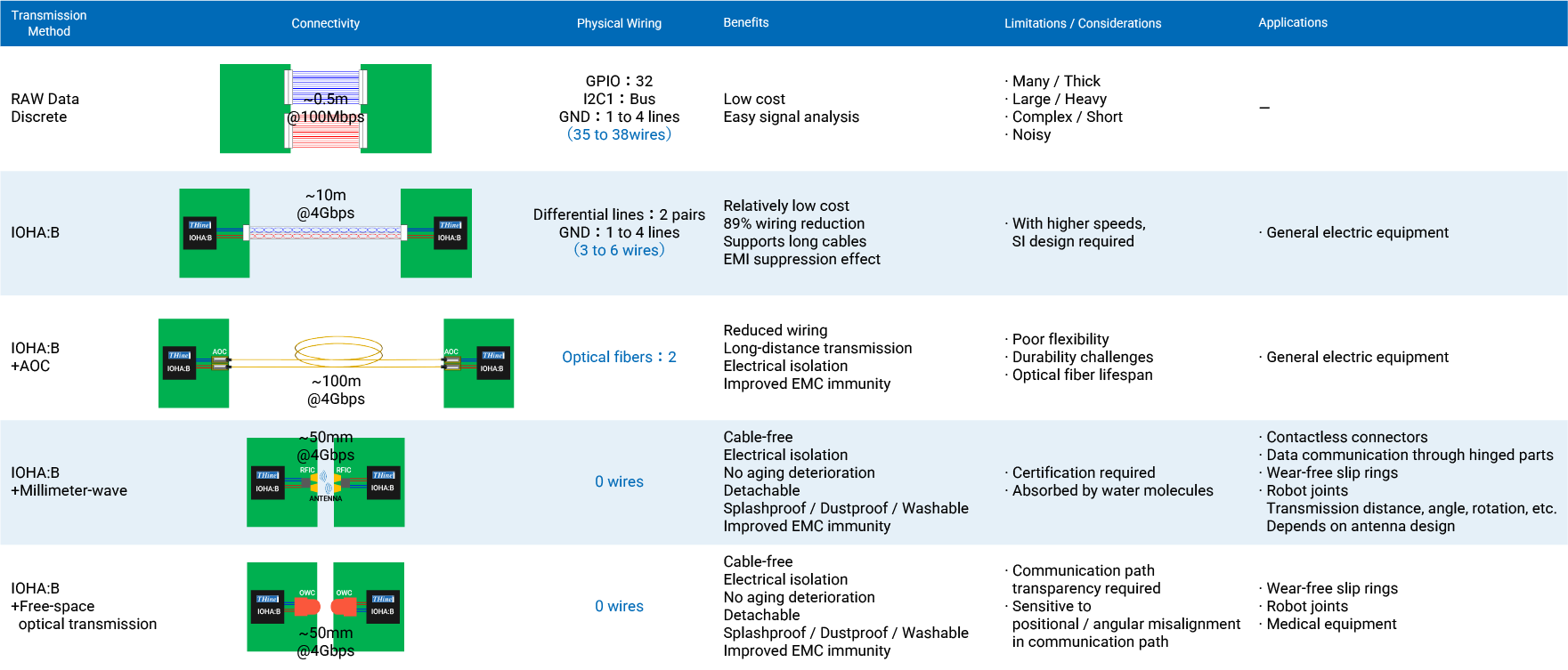
In other words, up to 35 signal lines can be converted into just two pairs (four wires) of serial signals. Reducing the number of cables provides a wide range of benefits (Table 1). For example, cable bundles can be made thinner and lighter, and cable connection work can be greatly simplified.
Initially, THine Electronics envisioned IOHA:B for board-to-bard and device-to-device connections, targeting applications such as industrial equipment, medical devices, measuring instruments, manufacturing systems, and display systems. That assumption proved correct, and adoption steadily expanded across these applications.
THine Electronics’ serial transceiver IC, THCS253A/254A, is one such highly versatile semiconductor device. This serial transceiver IC is marketed under the product series name IOHA:B (pronounced “I Oh Hub”). Using this IC makes it possible to consolidate video signals, image signals, general-purpose input/output (GPIO) signals, I2C signals, and other mixed signals into a single stream and transmit them over two differential pairs (Fig. 1).

Fig. 1 Expected Use Cases for IOHA:B
In other words, up to 35 signal lines can be converted into just two pairs (four wires) of serial signals. Reducing the number of cables provides a wide range of benefits (Table 1). For example, cable bundles can be made thinner and lighter, and cable connection work can be greatly simplified.
Table 1 Connections Methods for IOHA:B
Initially, THine Electronics envisioned IOHA:B for board-to-bard and device-to-device connections, targeting applications such as industrial equipment, medical devices, measuring instruments, manufacturing systems, and display systems. That assumption proved correct, and adoption steadily expanded across these applications.
Introducing Optical Fiber Transmission and Millimeter-Wave Communication
However, as these markets expanded, many users began requesting new and different ways to use it. Examples included requests for transmission over 100 meters, stronger electromagnetic compatibility (EMC) immunity, electrical isolation between transmitter and receiver, dustproof, splashproof, and salt-resistant data transmission, contactless connections that eliminate mechanical stress, and detachable connector connections. None of these needs can be fully met with ordinary differential cables alone. To address this, THine Electronics developed demo kits combining IOHA:B with optical fiber transmission (or active optical cable, AOC) and millimeter-wave communication. These demo kits have already been showcased at trade exhibitions and similar events.
In fact, IOHA:B is highly compatible with both optical fiber transmission and millimeter-wave communication. For optical fiber transmission, simply attach an optical transmitter (light emitter) to the data output side of IOHA:B, an optical receiver (photodetector) to the data input side, and connect optical fiber cables. This enables bidirectional data transmission (full-duplex communication) using two optical fibers. The same concept applies to millimeter-wave communication. Simply attach a millimeter-wave transmitter to the data output side and a millimeter-wave receiver to the data input side of IOHA:B to enable bidirectional data transmission (full-duplex communication) over millimeter waves.
By adopting optical fiber transmission, data can be sent over distances of up to approximately 100 meters, making applications such as sending surveillance camera footage to a nearby control room possible. Millimeter-wave communication, on the other hand, enables contactless connections free from mechanical stress, as well as detachable connector-style connections. As a result, in-process electronic products moving along a production line can be tested contactlessly without attaching mechanical connectors, while detachable camera modules can also enhance product design flexibility.
In addition, adopting optical fiber transmission or millimeter-wave communication can improve EMC immunity and provide electrical isolation. Millimeter-wave communication can also enable data transmission compatible with dustproof, splashproof, and salt-resistant designs.
In fact, IOHA:B is highly compatible with both optical fiber transmission and millimeter-wave communication. For optical fiber transmission, simply attach an optical transmitter (light emitter) to the data output side of IOHA:B, an optical receiver (photodetector) to the data input side, and connect optical fiber cables. This enables bidirectional data transmission (full-duplex communication) using two optical fibers. The same concept applies to millimeter-wave communication. Simply attach a millimeter-wave transmitter to the data output side and a millimeter-wave receiver to the data input side of IOHA:B to enable bidirectional data transmission (full-duplex communication) over millimeter waves.
By adopting optical fiber transmission, data can be sent over distances of up to approximately 100 meters, making applications such as sending surveillance camera footage to a nearby control room possible. Millimeter-wave communication, on the other hand, enables contactless connections free from mechanical stress, as well as detachable connector-style connections. As a result, in-process electronic products moving along a production line can be tested contactlessly without attaching mechanical connectors, while detachable camera modules can also enhance product design flexibility.
In addition, adopting optical fiber transmission or millimeter-wave communication can improve EMC immunity and provide electrical isolation. Millimeter-wave communication can also enable data transmission compatible with dustproof, splashproof, and salt-resistant designs.
Achieving 360-Degree Rotation with Free-Space Optical Transmission
However, optical fiber transmission and millimeter-wave communication are not universal solutions. In reality, there are cases where simply combining IOHA:B with optical fiber transmission or millimeter-wave communication cannot fully meet user needs. Two typical examples are outlined below.
The first is when users want to go wireless with millimeter-wave communication while minimizing implementation effort as much as possible. In general, when radio waves are used, certification of technical standards compliance under the Radio Law is required. Obtaining that certification requires a certain amount of time and effort.
The second is when users want to incorporate a mechanism that allows the interface section to rotate. Although slip rings and similar solutions can be implemented with differential cables, service life issues caused by wear are unavoidable.
To address these two needs, THine Electronics developed a demo kit supporting a new connection method (Fig. 2).
The connection method adopted is free-space optical transmission. Free-space optical transmission sends and receives data by projecting laser light through open space and receiving it with a photodiode. In other words, it is a wireless connection method. Although the transmission distance is limited to a maximum of 50 millimeters, it supports data rates of up to 4 Gbps.
However, simply attaching a standard laser to the data output side of the IOHA:B and standard photodiodes to each data input side would not enable 360-degree rotation. This is because bidirectional data transmission (full-duplex communication) must be supported. Because laser light travels in a straight line, rotating the interface 360 degrees would cause the laser and photodiode to lose alignment, just as with millimeter-wave communication. To solve this, a specially shaped optical device was adopted. Specifically, the optical transceiver used is the AFBR-FS50B00 from Broadcom Inc. (Fig. 3).
Viewed from above, this optical transceiver has a vertical-cavity surface-emitting laser (VCSEL) positioned at the center, with photodiodes arranged concentrically around it. Two of these optical transceivers are mounted facing each other on opposite sides of the interface section. The laser light propagates through space while spreading slightly, and is received by the opposing photodiodes (Fig. 4). As a result, if rotation occurs around the axis formed by the line connecting the opposing optical transceivers, data transmission remains uninterrupted even through a full 360-degree rotation. Naturally, because no radio waves are used, there is no need to obtain technical standards compliance certification.
The combination of IOHA:B and free-space optical transmission targets three major application areas. The first is rotary connectors, such as slip rings. The second is robot joints. The third is detachable cameras and displays. Applying this technology to such applications makes it possible to implement high-speed interfaces on rotating sections without complex mechanical structures.
Naturally, many other applications beyond these three examples are also possible. If you have ideas for new uses, THine Electronics would be pleased to hear from you. We would welcome the opportunity to create new applications together.
End
The first is when users want to go wireless with millimeter-wave communication while minimizing implementation effort as much as possible. In general, when radio waves are used, certification of technical standards compliance under the Radio Law is required. Obtaining that certification requires a certain amount of time and effort.
The second is when users want to incorporate a mechanism that allows the interface section to rotate. Although slip rings and similar solutions can be implemented with differential cables, service life issues caused by wear are unavoidable.
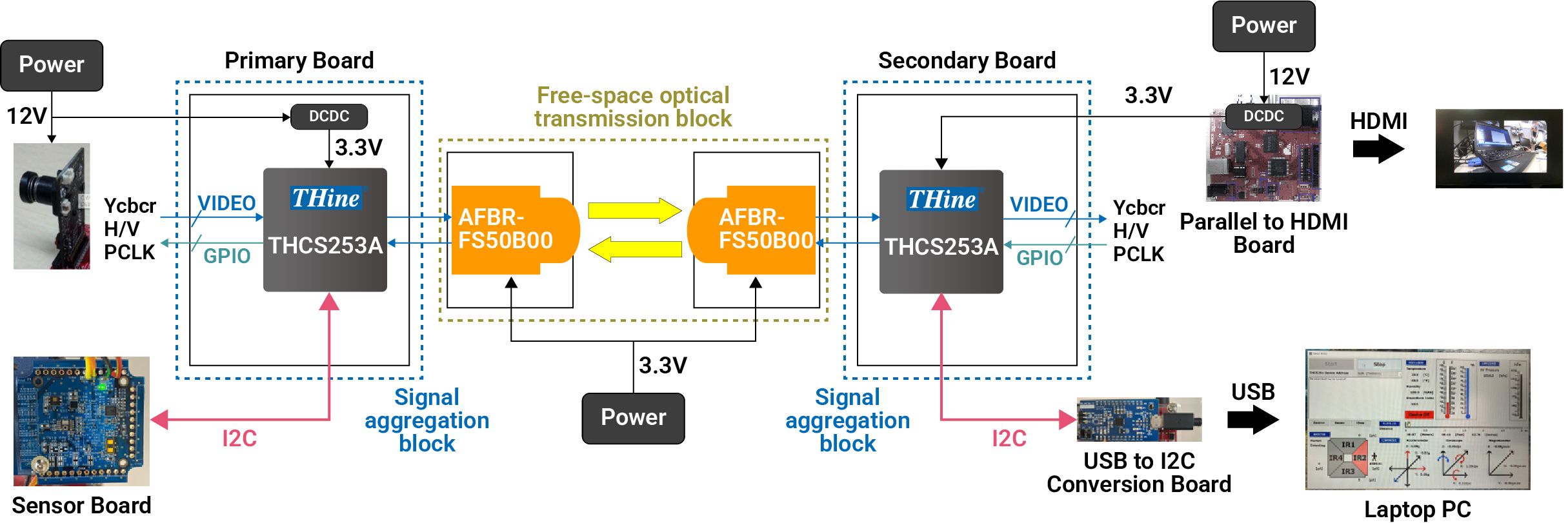
To address these two needs, THine Electronics developed a demo kit supporting a new connection method (Fig. 2).
Fig. 2 Block Diagram of a Demo Kit Applying Free-Space Optical Transmission to IOHA:B
The connection method adopted is free-space optical transmission. Free-space optical transmission sends and receives data by projecting laser light through open space and receiving it with a photodiode. In other words, it is a wireless connection method. Although the transmission distance is limited to a maximum of 50 millimeters, it supports data rates of up to 4 Gbps.
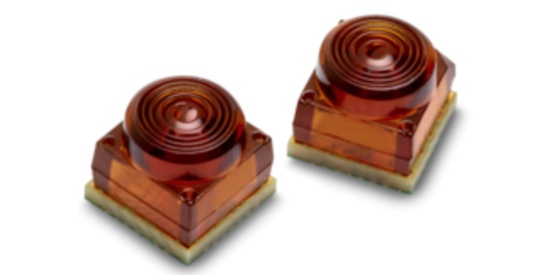
However, simply attaching a standard laser to the data output side of the IOHA:B and standard photodiodes to each data input side would not enable 360-degree rotation. This is because bidirectional data transmission (full-duplex communication) must be supported. Because laser light travels in a straight line, rotating the interface 360 degrees would cause the laser and photodiode to lose alignment, just as with millimeter-wave communication. To solve this, a specially shaped optical device was adopted. Specifically, the optical transceiver used is the AFBR-FS50B00 from Broadcom Inc. (Fig. 3).
Fig. 3 Optical Transceiver Used in This Design
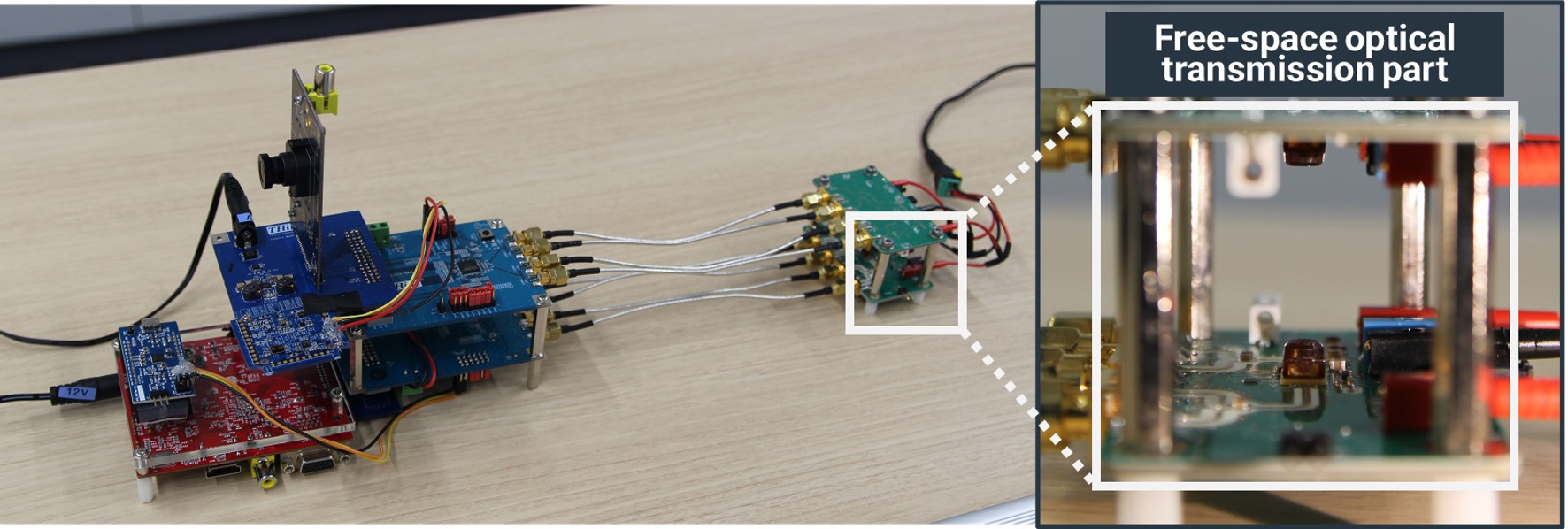
Viewed from above, this optical transceiver has a vertical-cavity surface-emitting laser (VCSEL) positioned at the center, with photodiodes arranged concentrically around it. Two of these optical transceivers are mounted facing each other on opposite sides of the interface section. The laser light propagates through space while spreading slightly, and is received by the opposing photodiodes (Fig. 4). As a result, if rotation occurs around the axis formed by the line connecting the opposing optical transceivers, data transmission remains uninterrupted even through a full 360-degree rotation. Naturally, because no radio waves are used, there is no need to obtain technical standards compliance certification.
Fig. 4 External View of the Free-Space Optical Transmission Demo Kit
The combination of IOHA:B and free-space optical transmission targets three major application areas. The first is rotary connectors, such as slip rings. The second is robot joints. The third is detachable cameras and displays. Applying this technology to such applications makes it possible to implement high-speed interfaces on rotating sections without complex mechanical structures.
Naturally, many other applications beyond these three examples are also possible. If you have ideas for new uses, THine Electronics would be pleased to hear from you. We would welcome the opportunity to create new applications together.
End